Experiment
Split: A personal household financial management tool.
Building a household finance management app that manages bills the way we want to.

The Opportunity
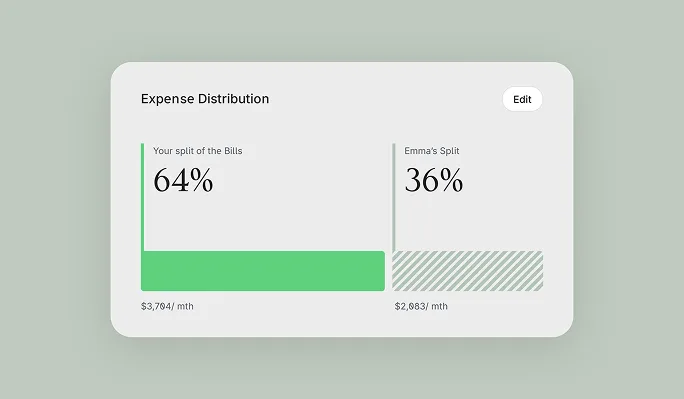
Every couple eventually has to figure out how they'll approach money. For me and Emma it was clear: if I have 30% of my income left over after bills, Emma should have 30% left over too. It means one of us may pay more, but the bills land as an equal burden on our incomes, rather than an equal number.
Our incomes rarely move in lock-step, so I kept a spreadsheet, updating it whenever the split needed to change. It always worked, but the smarter or more technical it got, the harder it got for both of us to review or update it. Okay fine, the harder I made it for anyone who wasn't me to update.
The Approach
It's not a complicated app, but I used it to familiarise myself with Claude Code's capabilities, working toward a specific design outcome rather than just accepting what the AI gave me. Understanding the capabilities, limitations, and any tricks would matter if I were to try to use AI to build things at work.
I started by getting Claude to recreate a digital version mirroring my spreadsheet's structure, then moved onto accounts management with password-less access, a requirement I was particularly interested to explore. I had it build the split mechanism where I could adjust a salary and the system would suggest a new split. I could either accept the recommendation or override it, and it would flow across all the bills.
Once it was functionally working, I spent an evening building the key pages in a style or "brand" that fit, then got Claude to work on the styling. AI never one-shots things. The best approach I've found is isolating a component, element or feature, and refining the detail piece by piece.
A learning I took from this process was that you don't have to work in-situ. For repeated patterns like an array of modals I was using, I got Claude to extract them into their own playground where I could quickly and easily click through all of them and refine the consistent or shared elements. Less distraction, just a safe space to iterate.
The Outcome
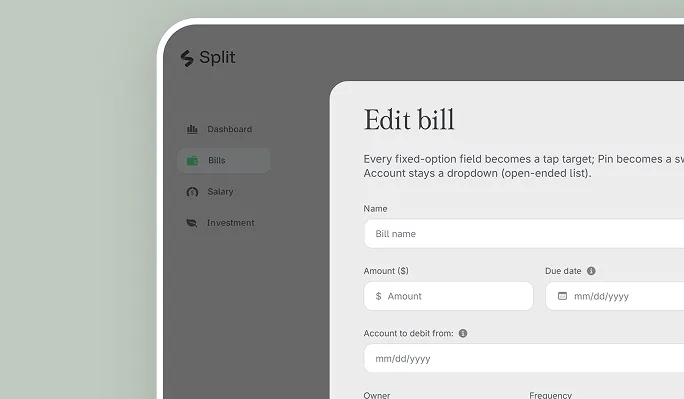
I had a few requirements: accounts, a dashboard that responds to whoever's looking at it, accessible online, recommended splits I can override, and no passwords to memorise or save.
Accounts are accessed by magic links. The dashboard defaults to whoever's logged in. Subtle colour flair on badges helps me see my bills at a glance.